 how-to
How to Open a Locked Car Door Safely: 2026 Guide
Table of Contents
- What to Do Before You Try to Open a Locked Car Door
- Safe DIY Methods to Open a Locked Car Door
- When to Call Automotive Lockout Services
- What Affects the Cost of Professional Car Lockout
- How to Prevent Car Lockouts Before They Happen
- Safety Precautions and Legal Considerations for Locked Vehicles
- Frequently Asked Questions
Last Updated: September 25, 2026
What to Do Before You Try to Open a Locked Car Door
Few things feel worse than watching your keys sit on the driver's seat while the door stays shut. According to NHTSA vehicle safety resources, millions of drivers face lockouts every year, and how you respond in the first few minutes decides whether you drive home or pay for a repair. A locked car door is a solvable problem, but only if you slow down and diagnose it first.
Check Every Door and the Trunk First
Walk the whole car before assuming it's locked; testing only the driver side door is a common mistake.
- Try all four doors, including the rear ones
- Test the trunk or liftgate release
- Check the fuel door, which sometimes links to the central lock
- Look for a hidden mechanical key slot under a plastic cap
Confirm the Lockout Type: Dead Battery, Lost Key, or Mechanical Failure
The right fix depends on why the door won't open. There are three main causes.
- Dead battery: the fob won't talk to the car, or the car won't respond at all
- Lost or locked-in key: the key is gone or sitting inside
- Mechanical failure: the fob works but the latch or actuator won't move
Safe DIY Methods to Open a Locked Car Door
Once you know the lockout type, the safe path depends on your vehicle's lock system. A 2015 sedan with a traditional ignition key and a 2024 model with push-button start are built differently, and the wrong technique can cost you a door panel, a window regulator, or a $300-plus repair.
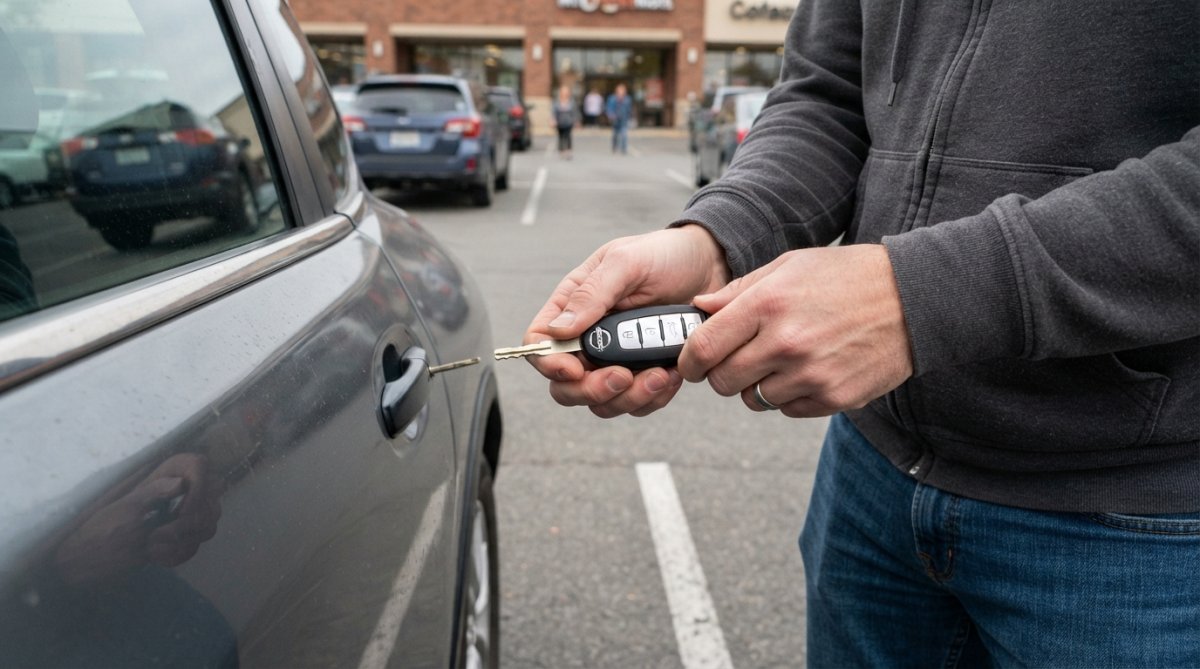
Match the Method to Your Lock Architecture
Before you reach for anything, identify which system you have. This single step prevents most DIY damage.
- Traditional ignition key (pre-2010s, many trucks and base models): a physical key cylinder in the driver door, a manual lock pin or slide on the interior panel, and a mechanical linkage to the latch. These respond to the key blade, a lockout tool, or a coat hanger through a cracked window.
- Transponder key with remote fob (roughly 2000-2015): the door still has a key cylinder, but the fob also drives a power lock actuator. The blade works even when the fob battery is dead; the actuator does not.
- Push-button start with smart key (most 2015+ vehicles): the door may have a hidden key cylinder under a plastic cap, or none at all. If there is no visible keyhole, do not force anything into the handle, you will break the cap or the handle trim.
Using the Mechanical Key Blade Hidden in Your Fob
Nearly every remote transmitter built in the last two decades holds a backup key blade. Look for a small button or slot on the fob and slide the blade free.
- Find the release tab or slot on the fob housing
- Pull the key blade out
- Locate the hidden keyhole on the driver side door, often under a small cap
- Pry the cap off gently with the blade tip, plastic trim tools work better than a screwdriver
- Insert the blade and turn to unlock
Damage-Free DIY Entry Techniques for Lost or Locked-In Keys
If the key is inside the car and no door will open, you have three damage-free options.
- The wedge-and-reach method: a plastic or rubber air wedge slides into the top corner of the driver door, just enough to create a finger-width gap. A long-reach tool or a stiff wire with a hook then presses the interior unlock button or pulls the manual lock pin. Inflate the wedge slowly and never pry against the glass, the window can crack if you lever on it.
- The shoelace or strap trick (older vehicles only): on cars with a vertical manual lock pin, a looped cord can be worked down between the glass and the weather stripping and snagged over the pin. This does not work on modern cars with horizontal or flush lock buttons, or on any vehicle with a dead-locked or shielded latch.
- The trunk pass-through or folding rear seat: many sedans and SUVs have a release inside the trunk or a folding rear seat that opens into the cabin. If you can open the trunk with the mechanical blade, you may be able to fold the seat and reach the interior door handle, the safest method because it uses the car's own access points.
Manual Door Handle and Interior Latch Operation
If you can reach inside, the interior handle and latch assembly are your fastest route. This applies when a window is cracked, a door is ajar, or a passenger can reach the lock.
- Pull the interior handle once to unlock and again to open on many cars
- Push the manual lock pin up on older vehicles
- Use the emergency release if you're already inside
- On double-locked doors, the interior handle may not work at all, that is a design feature, not a fault
Emergency Exit From Inside the Vehicle
Being locked in is a different, safety-critical problem. Every car sold in the U.S. has an emergency trunk release, and most have a manual door override.
- Pull the glow-in-the-dark trunk release handle to escape a locked trunk
- Use the mechanical door handle, not the electronic button, if power is out
- Lower a rear window and reach for the exterior handle if the door won't open
- On some models, the rear doors have a child safety lock that prevents them from opening from the inside, check the edge of the door for a small switch
What Not to Do
- Do not use a coat hanger on a modern car with side-curtain airbags in the roof rail, the wire can snag the airbag wiring and trigger a repair that runs into the hundreds.
- Do not spray lubricant into a keyhole to free a stuck cylinder; it attracts dirt and makes the problem worse.
- Do not force a key blade that will not turn. If the blade goes in but will not rotate, the cylinder or the linkage is the problem, not the key.
- Do not pry on the window glass or the top of the door frame. Tempered glass and modern door frames do not flex the way older vehicles did.
When to Call Automotive Lockout Services
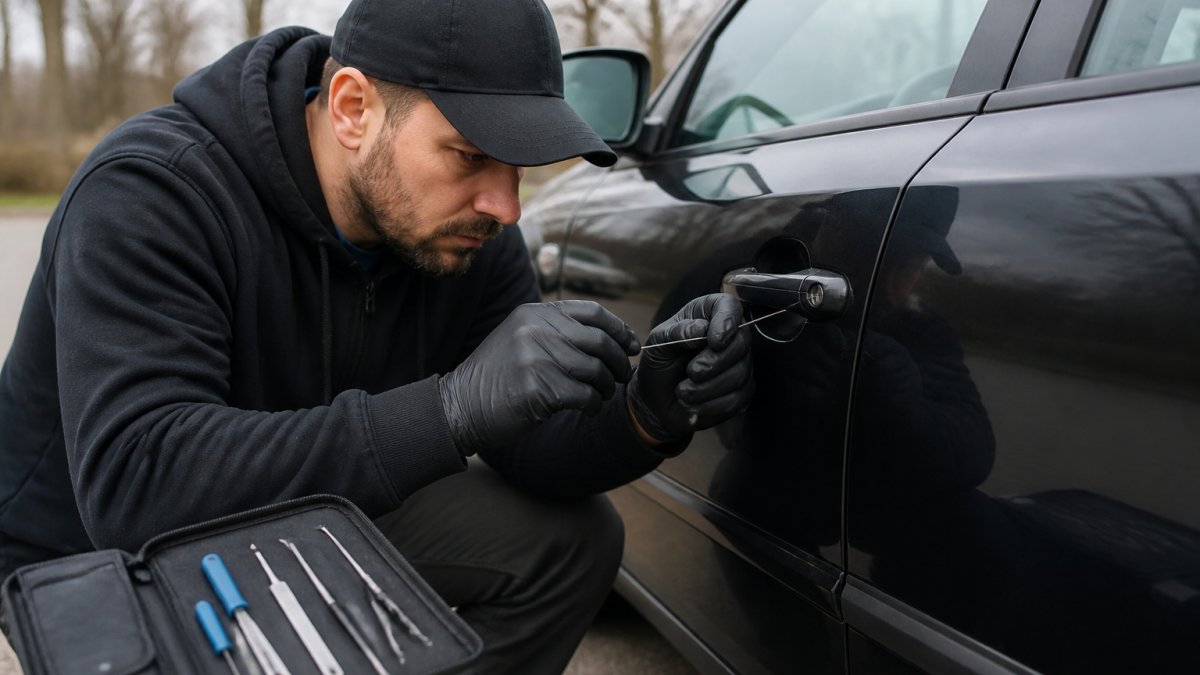
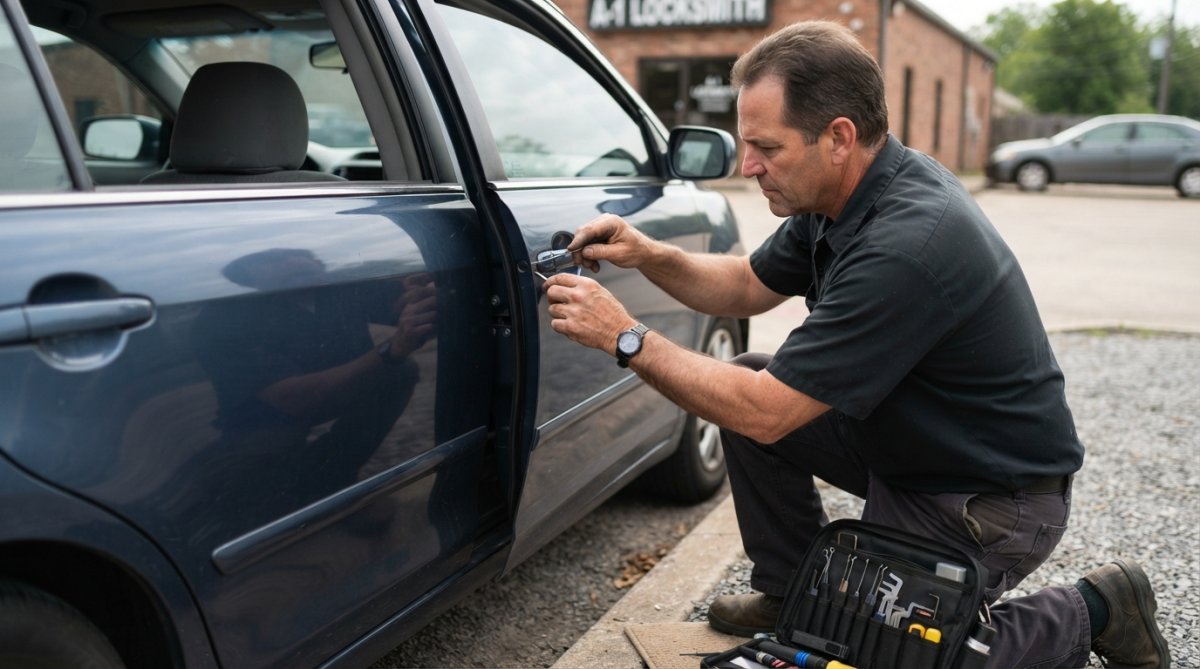
DIY has limits, and knowing when to stop protects your car. Call a professional when the fob is lost, the key is trapped deep inside, or the latch won't budge after two honest attempts. Professional automotive lockout services use slim jim tools, wedge kits, and long-reach tools that open doors without damage, and a trained technician reads your vehicle's lock architecture to pick the right tool.
Here's when to make the call:
- The key is lost, not just locked inside
- Your car has a transponder or smart key system
- The door won't open even with the mechanical blade
- You've already tried for more than 15 minutes
| Lockout Type | Best First Move | When to Call a Pro |
|---|---|---|
| Dead fob battery | Use hidden key blade | Blade won't turn |
| Key locked inside | Check all doors and trunk | No door opens |
| Lost key | Call a locksmith | Immediate |
| Mechanical failure | Try interior handle | After 2 attempts |
| Child or pet inside | Call 911 | Immediate |
What Affects the Cost of Professional Car Lockout
The cost of a professional car lockout depends on a few clear factors, not a single flat rate. The cost of a professional car lockout depends on a few clear factors. Always ask for the all-in price before the technician starts.
- Vehicle type: older cars with simple locks cost less than smart key systems, which may require a scan tool or a programming step even for a simple unlock
- Lockout type: a slim jim or wedge entry differs from a lost-key replacement, which can run several hundred dollars once the new key is cut and programmed
- Time of day: after-hours and emergency calls often carry a higher rate
- Distance: rural and outlying areas may add a trip charge, sometimes a flat fee plus a per-mile amount
- Key replacement: programming a new transponder key costs more than a simple unlock, and some manufacturers require a dealer visit for certain models
Check Your Insurance and Roadside Coverage First
Before you pay out of pocket, check whether someone else already covers the call. Many auto insurance policies include lockout service as part of roadside assistance, and several credit cards and membership programs bundle it as a benefit.
- Auto insurance roadside assistance: often a small add-on to a comprehensive or collision policy; the lockout itself may be covered up to a set dollar amount per event
- Membership roadside programs: commonly include lockout service as a standard benefit, with limits on how many calls per year
- Credit card benefits: some premium cards include roadside dispatch as a cardholder perk, but the coverage terms vary widely
- New-car warranties: some manufacturers include roadside assistance for the first few years of ownership, and lockout service is frequently part of that package
Legal and Liability Considerations Before You Force Entry
Opening a car you do not own can create legal exposure even with good intentions.
- Only unlock a vehicle you own or have explicit permission to access. Helping a stranger by prying their door can be treated as unauthorized entry or vandalism if something breaks.
- Carry proof of ownership. Registration or title in your name resolves most questions if law enforcement arrives while you are working on your own car.
- Damage is on you. If a DIY attempt scratches paint, tears weather stripping, or cracks a window, that is generally your responsibility, not the manufacturer's or the locksmith's.
- Insurance may not cover DIY damage. Many policies cover lockout service but exclude damage caused by the owner's own forced entry attempt. Read the exclusions before you assume a claim will go through.
- Locksmith licensing varies by state. Some states require locksmiths to hold a license and carry insurance; asking for a license number before you hire is a reasonable and common practice.
How to Prevent Car Lockouts Before They Happen
Most lockouts come down to habits, not bad luck.
- Keep a spare mechanical key in a safe place, not inside the car
- Replace the fob battery every couple of years before it dies
- Never leave the key in the ignition or on the seat
- Use a key check habit every time you close the door
- Program a backup key for smart key vehicles
If your fob feels sluggish, the battery is fading. Swap it early and you'll skip the dead-battery lockout entirely.
Safety Precautions and Legal Considerations for Locked Vehicles
Opening a car you don't own can land you in legal trouble, even with good intentions. Only unlock a vehicle you own or have written permission to access.
- Carry your registration or title to prove ownership if police arrive
- Never try to open a stranger's car, even to help
- Don't damage property; forced entry can count as vandalism
- Check your insurance policy for lockout coverage before you pay out of pocket
Frequently Asked Questions
How do you unlock your car if your keys are locked inside?
First, check every door and the trunk, since some vehicles unlock all doors when the interior handle is pulled twice. If that fails, look for a hidden mechanical key blade inside your key fob that can open the driver side door lock cylinder. If neither works, call a licensed automotive lockout service. They use damage-free tools like air wedges and long-reach rods to open a locked car door safely without breaking glass or bending the door frame.
What is the safest way to open a locked car door without a key?
The safest method is a mechanical key blade from your fob or a professional lockout service. DIY techniques like coat hangers or wedge tools can scratch paint, damage weather stripping, or trigger the security system. If you must try a DIY approach, never use force on the door handle assembly or latch mechanism. Professional technicians are trained to work with your vehicle's specific lock architecture, which reduces the risk of costly repairs.
Does insurance cover automotive lockout services?
Many auto insurance policies cover lockout services through roadside assistance add-ons, and some credit cards include it as a benefit. Check your policy details or call your provider before assuming coverage. If you do not have coverage, the cost of professional car lockout depends on your vehicle type, time of day, and location. A-1 Locksmith provides transparent pricing before any work begins, so you know what to expect.
How can I prevent car lockouts in the future?
Keep a spare key in a secure location like a magnetic hide-a-key box or your wallet, and replace your fob battery every two to three years to avoid dead battery surprises. Never leave keys inside the vehicle, even for a quick stop. If your vehicle has keyless entry, confirm the fob is in your pocket before closing the door. These habits dramatically reduce how to prevent car lockouts from becoming an emergency.
A locked car door is stressful, but it's rarely the emergency it feels like. Slow down, check every door, and use the mechanical key blade before you reach for a tool. When the job needs a pro, A-1 Locksmith offers 24/7 emergency availability, licensed and insured technicians, and transparent pricing so you know the cost before we start. Get in touch with A-1 Locksmith and get back on the road with your vehicle and your peace of mind intact.