 How-to
7 Things an Emergency Locksmith Coverage Area Map Reveals
Last Updated: November 24, 2026
Quick Summary
An emergency locksmith coverage area map shows the exact geographic zone a locksmith serves, using shaded zones for standard service and boundary lines marking the outer limits. At A-1 Locksmith, we publish ours so you know before you call whether we can reach you, and roughly how fast.
- Locate your exact street address on the map, not just your town, because coverage often stops at county lines.
- A dark core zone usually means faster response, while a lighter outer ring means longer arrival and possibly a travel charge.
- Ask whether a trip charge or minimum fee applies to your distance before you agree to dispatch.
- Confirm the map's last-updated date, since coverage polygons change as operators add or pull vans.
- Give dispatch your full street address, not your town, so they can check the boundary in seconds.
Table of Contents
- What Does an Emergency Locksmith Coverage Area Map Show You?
- How to Read a Locksmith Service Area Map Before You Call
- How to Verify Your Address Is Inside the Coverage Boundary
- Emergency Locksmith Response Time: What Drive-Time Estimates Really Mean
- The Mobile Locksmith Service Area and How Far Out It Reaches
- Emergency Locksmith Cost: Service Calls, Travel Fees, and What Drives the Total
- Confirm Your Address and Get a Technician Dispatched
- Frequently Asked Questions
What Does an Emergency Locksmith Coverage Area Map Show You?
An emergency locksmith coverage area map shows the exact geographic zone a locksmith company serves, including shaded zones for standard service, boundary lines marking the outer limits, and sometimes separate zones for different service types.
The global emergency locksmith market is projected to grow from USD 3,441 million in 2025 to USD 5,954 million by 2032, according to Market Research Reports' market forecast, which means more choices for homeowners and more reason to check who actually covers your street.
Here's what most people get wrong: they call the first number they find, then discover the truck is 40 minutes away or that their address sits outside the boundary. Reading the map first saves that entire conversation.
What the Shaded Zones and Boundary Lines Mean
Shaded zones usually mark the core service area, where a locksmith runs trucks regularly and can promise fast arrival. Boundary lines mark the outer edge of coverage. Inside the line, you're covered. Outside it, you may be quoted a longer wait or a trip charge, or told no.
Some maps use two or three shades. A darker core zone might mean 15-25 minute drive times, while a lighter outer ring means longer. Emergency operations typically publish 15-25 minute drive-time areas, while business-hours work often extends to 30-45 minutes, according to Radius Mapper's service area guidance.
Why Coverage Is Split by Service Type
A lockout is not the same job as a vault service call. Emergency lockout work, residential rekeying, automotive key programming, and commercial vault maintenance all need different equipment and different technicians.
That's why one company's map may show a tight zone for emergency response and a wider one for scheduled work. If your address is in the outer ring, you may still get service, just not at 2 a.m. on a Sunday.
How to Read a Locksmith Service Area Map Before You Call
Most coverage maps are built from the same few layers, and knowing what each layer represents tells you more than the company's marketing copy does. A typical emergency locksmith coverage area map combines a base street map, one or more shaded service polygons, a boundary line marking the outer limit, and point markers for dispatch hubs or technician staging locations.
Read the map in this order:
- Locate your exact address, not your town. Zoom to street level and find your block. Coverage often stops at a county line, a municipal boundary, or a highway interchange, so a town-level match can be misleading.
- Identify which polygon your address falls inside. A dark core zone usually means trucks stage nearby and response is fastest. A lighter outer ring usually means longer arrival and possibly a travel charge. If your address sits on the line itself, treat it as outer-ring until dispatch confirms otherwise.
- Check whether the map separates emergency and scheduled zones. Many operators draw a tight polygon for after-hours lockouts and a wider one for daytime rekeys, installations, and commercial work. Your address can be inside one and outside the other.
- Look for a stated response window per zone, not one blanket number. A map that says "15-25 minutes" across the whole shaded area is usually describing the core, not the edge.
- Note any trip charge or minimum-fee note tied to the outer ring. If the map does not state it, ask before dispatch.
- Confirm the last-updated date. Coverage polygons change as operators add or pull vans, and an old map can promise service the dispatcher cannot deliver.
Reading the Map When You Cannot Use an Interactive Version
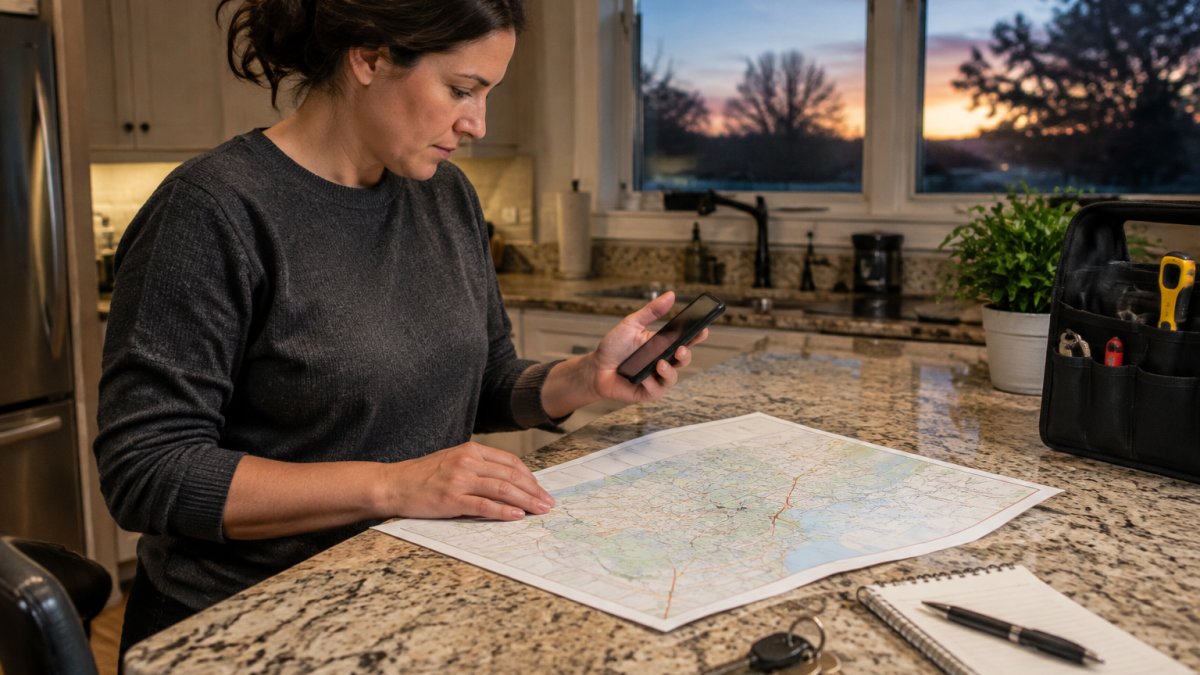
Not every reader can pan and zoom a web map, and not every map loads cleanly on a phone in a parking lot at night. A well-built coverage page pairs the interactive map with a plain text list of covered cities, ZIP codes, or neighborhoods, plus a searchable address field. If the page you are on offers only a graphic, use the browser's text search on the surrounding page to find your ZIP code, and if that fails, call dispatch and read your full address aloud. Accessibility is a practical test of how well a locksmith has actually thought about coverage, not an afterthought.
How to Verify Your Address Is Inside the Coverage Boundary
Call and give your full street address, not your town. "I'm in Huntsville" tells a dispatcher almost nothing, because coverage often stops at a county line or a highway. Your exact address lets them check the boundary in seconds.
The Federal Trade Commission's guidance on choosing a locksmith recommends asking for the company's physical address and confirming the total price before work begins. A coverage map plus a physical business address is a much stronger signal than a toll-free number and a generic website.
What the Boundary Actually Represents
A coverage boundary is rarely a perfect circle. Most operators draw it around dispatch hubs, major roads, and the ZIP codes where they already run vans regularly, then trim it where drive times get unreliable. That is why an address two miles outside the line can sometimes be served while an address inside the line but across a river or behind a closed bridge can still get a long estimate. The boundary is a planning tool, not a legal guarantee.
Common exclusions and edge cases to ask about:
- Outlying communities and rural routes. Long private drives, ranch roads, and addresses without standard street numbers often fall outside the drawn polygon even when the surrounding county is shaded.
- Islands, peninsulas, and bridge-dependent areas. A short straight-line distance can mean a long actual drive.
- Gated communities and secured buildings. Coverage may exist but access procedures can add time.
- Technician availability at the moment you call. A boundary can be inside the map and still outside the realistic response window at 2 a.m. on a holiday.
How to Confirm Coverage in One Call
Keep it short and specific. Dispatchers triage calls, and clear details move you up the list.
- Your full address, including any gate code or rural route detail
- What is locked: house, car, business, or outbuilding
- Whether anyone is inside or at risk
- Your vehicle's make, model, and year if it is an auto lockout
- A callback number that rings
Then ask three direct questions before you agree to dispatch: Is my exact address inside your standard service area? Is there a trip charge or minimum fee for my distance? What arrival window are you quoting right now, tonight, for this address? A dispatcher who can answer all three without checking with someone else is usually working from a live coverage tool rather than a printed list.
Rural addresses deserve a mention. If you are on a ranch or a long private drive, say so. It changes the arrival estimate and sometimes the price.
Emergency Locksmith Response Time: What Drive-Time Estimates Really Mean
A drive-time estimate is the time to reach you under normal conditions, not a guarantee. Traffic, weather, and call volume all move the real number. When a company quotes 30 minutes, ask whether that's drive time or total time from dispatch.
Nights and weekends are the least-covered periods for locksmith operations, according to The Keybot's operator field analysis, which is exactly when most lockouts happen. A company that answers at 2 a.m. with a real person on the phone is telling you something the map can't.
For a deeper look at what shapes those numbers, see our guide to emergency locksmith response time expectations.
The Mobile Locksmith Service Area and How Far Out It Reaches
A mobile locksmith brings the shop to you, which means the service area is really a question of how far a van will drive. That radius is usually tighter than people expect for emergency work.
There are 25,883 identified locksmith contacts in the United States as of 2026, according to Scrap.io's industry contact database, but density on a directory page says nothing about who will actually reach a rural address at night.
If you're well outside the core zone, ask two questions: is there a trip charge, and what's the realistic arrival window. Our emergency locksmith service area radius guide covers how these boundaries get drawn.
Emergency Locksmith Cost: Service Calls, Travel Fees, and What Drives the Total
Emergency locksmith cost depends on the service call base, travel distance, time of day, and the hardware involved. A lockout is usually the simplest job. Key programming, lock replacement, and vault work add parts and labor.
We won't publish a price here because it changes with the job. Our guide to avoiding locksmith hidden fees explains the line items to ask about.
| Cost Factor | What It Covers | How to Check It |
|---|---|---|
| Service call | Base charge to dispatch a technician | Ask if it applies after hours |
| Travel fee | Distance outside the core zone | Confirm against the coverage map |
| Time-of-day rate | Nights, weekends, holidays | Ask for the after-hours rate upfront |
| Parts and hardware | Locks, cylinders, keys, fobs | Request itemized pricing |
| Labor | Programming, installation, repair | Ask for a flat quote per job |
Confirm Your Address and Get a Technician Dispatched
The fastest path is a short call with your address ready. A-1 Locksmith has served Huntsville since 1970, with licensed and insured technicians handling automotive, residential, and vault work.
We answer around the clock, and we can confirm your address against our coverage boundary while you're on the phone. Start with our services page to see what we handle, or reach out through our contact page to get a technician dispatched.
Locked out at an odd hour with no idea whether anyone covers your street? Call A-1 Locksmith and we'll confirm your address against our service area, give you a realistic arrival window, and quote the job before we roll.
Frequently Asked Questions
How can I tell whether an emergency locksmith serves my address?
Check the company's coverage area map first, then confirm by phone. Give dispatch your full street address, not just the town, because coverage boundaries often cut through rural routes and county lines. Ask directly whether your address falls inside the zone and what drive time they estimate. A-1 Locksmith has served the Huntsville area since 1970 and covers addresses across a 90-mile radius, so a quick call settles it faster than guessing from a map alone.
Does a coverage area map guarantee a specific response time?
No. A coverage area map shows whether a locksmith will travel to your address, not how fast they will arrive. Published drive-time estimates assume normal traffic and available technicians. Weather, rush hour, road closures, and call volume at that moment all change the real number. Treat the map as a yes-or-no answer on coverage and ask dispatch for a current arrival estimate when you call.
What drives emergency locksmith cost, and will I know it before the technician arrives?
The total usually depends on the time of day, the type of lockout, the hardware involved, and travel distance from the nearest technician. After-hours and weekend calls typically cost more than business-hours calls. Ask for the service call fee, any travel fee, and the labor rate before you agree to the job.
I live near the edge of the service area. What should I do?
Call and describe your location with a landmark or cross street, plus your address. Edge-of-area addresses are often still covered, but the technician may come from a farther staging point, which affects arrival time and possibly a travel fee. Ask whether the trip charge changes at the boundary.