 How-to
Emergency Locksmith Service Area Radius: 2026 Guide
Last Updated: October 23, 2026
Quick Summary
An emergency locksmith service area radius is the geographic boundary, measured in drive time rather than straight-line distance, within which a locksmith will dispatch a technician for lockouts, key replacement, and lock repair. The industry standard for emergency response is a 15- to 25-minute drive, with some rural providers extending to 30-45 minutes.
- Locksmiths calculate coverage by drive time, not miles on a map, so ask for your estimated drive time in minutes.
- A tight 5- to 15-mile targeting radius outperforms broad city-wide coverage for emergency lockout work.
- Travel fees are structured as flat service call fees, distance-based charges, or drive-time tiers, so confirm the structure.
- After-hours premiums, weekend rates, and holiday surcharges stack on top of travel charges.
- Give your full street address and ZIP code, then request the all-in quote before authorizing dispatch.
Table of Contents
- Why an Emergency Locksmith Service Area Radius Decides Who Shows Up
- How Locksmith Service Area Radius Is Calculated by Drive Time
- Emergency Locksmith Response Time: What Affects Your Arrival Estimate
- Emergency Locksmith Travel Fee: What Distance Adds to the Bill
- How to Verify a Locksmith's Service Area Before Booking
- Questions to Ask an Emergency Locksmith Before You Commit
- What to Do While You Wait for the Locksmith to Arrive
- Frequently Asked Questions
Why an Emergency Locksmith Service Area Radius Decides Who Shows Up
An emergency locksmith service area radius is the geographic boundary, measured in drive time rather than straight-line distance, within which a locksmith will dispatch a technician for lockouts, key replacement, and lock repair.
The stakes are larger than one bad night. The emergency locksmith service market was valued at USD 3.52 billion in 2025 and is projected to reach USD 5.5 billion by 2035, according to WiseGuyReports market analysis. With 29,620 locksmith businesses competing nationwide per IBISWorld industry data, the difference between a fast arrival and a two-hour wait usually comes down to whether your address sits inside a real coverage boundary.
A-1 Locksmith has been serving the community since 1970, and the pattern is consistent: the callers who get help fastest checked coverage before they needed it. Below, we explain how radius is calculated, what travel fees add, and how to verify a service area before you commit.
How Locksmith Service Area Radius Is Calculated by Drive Time
Locksmiths calculate service area radius by drive time, not by miles on a map. The industry standard for emergency response is a 15- to 25-minute drive, according to RadiusMapper's locksmith service area guidance, with some rural providers extending to 30-45 minutes.
Ten miles through open highway and ten miles through a congested commercial corridor are not the same job. A shop that quotes a mileage radius is telling you where it will drive; a shop that quotes drive time is telling you when it will arrive.
Distance vs. Drive Time: Why the Difference Matters
Distance is a straight line. Drive time is the road you actually travel. A locksmith two miles away across a river with one bridge crossing can take longer to reach you than one six miles out on the same side of the highway.
When you call, ask a direct question: "What is my estimated drive time from your nearest technician?" If the dispatcher cannot answer that, the coverage claim is marketing, not logistics.
Emergency Locksmith Response Time: What Affects Your Arrival Estimate
Emergency locksmith response time is the total elapsed time from your call to a technician at your door, and it combines dispatch time, drive time, and job complexity. A tight 5- to 15-mile targeting radius outperforms broad city-wide coverage for emergency lockout work, per Webtonic's locksmith ad performance data, largely because shorter drives mean faster arrivals.
Four factors move that estimate:
- Technician location at the moment of your call - the single biggest variable
- Traffic and road conditions - a 15-minute drive becomes 30 at rush hour
- Time of day - overnight calls often arrive faster than 5 p.m. Friday calls
How Coverage Changes by Time of Day and Demand
Coverage is not static. A shop that reaches you in 20 minutes at 10 a.m. may take 45 during a storm or holiday weekend, when call volume spikes and technicians are spread across active jobs.
Ask about after-hours service explicitly. Many providers maintain 24/7 availability but run thinner overnight crews, which stretches drive times in outer areas first. Rural addresses feel this most.
Emergency Locksmith Travel Fee: What Distance Adds to the Bill
An emergency locksmith travel fee is a separate charge covering the technician's drive to your location, and it is where distance shows up on the invoice. The useful question is how the number is built, because two shops quoting the same radius can produce very different totals.
Providers typically structure travel charges one of three ways:
| Fee Structure | How It Works | What to Confirm Before Dispatch |
|---|---|---|
| Flat service call fee | One charge regardless of distance | The exact radius the flat fee covers, and what happens if you sit just outside it |
| Distance-based | Per-mile charge beyond a base zone | Where the base zone ends and the per-mile rate that applies after it |
| Drive-time tiers | Higher fee for longer estimated drives | The tier boundaries in minutes and the fee attached to each tier |
How a Mileage Charge Is Actually Calculated
A distance-based travel fee is measured from the dispatch point, the technician's current location or nearest staging lot, to your address along the road network, not from your house to the shop's front door.
A common pattern is a base zone covering the first several miles or first 15 to 20 minutes of drive time at no extra travel charge, with a per-mile rate beyond that boundary.
Ask the dispatcher to walk the math out loud: base zone, distance beyond it, per-mile rate, and any after-hours multiplier.
After-Hours and Demand Premiums Stack on Top
Travel is only one line. After-hours premiums, weekend rates, and holiday surcharges are usually a percentage of the labor rate or a flat add-on, and they stack with travel. A job quoted at a weekday rate can land noticeably higher at 2 a.m. on a holiday, not because the drive got longer but because the rate structure changed.
Confirming the Quote Before You Authorize Dispatch
A reliable quote has four parts: the service call charge, the travel component for your address, the labor rate for your job, and any after-hours or demand premium. Get all four as a single total, and confirm it will not change unless the job itself changes, for example, a lockout that turns into a rekey because the cylinder fails.
If a dispatcher will not put a number on the travel portion before sending a technician, treat that as a warning sign. So is a quote dramatically lower than every other shop you called; an unusually low number usually means the travel and after-hours lines are waiting on the invoice rather than in the quote.
How to Verify a Locksmith's Service Area Before Booking
You verify a locksmith's service area by confirming three things: your address falls inside a stated drive-time boundary, the provider can name the technician's current location, and the travel fee for your specific address is quoted up front. Any provider that cannot clear all three is a gamble.
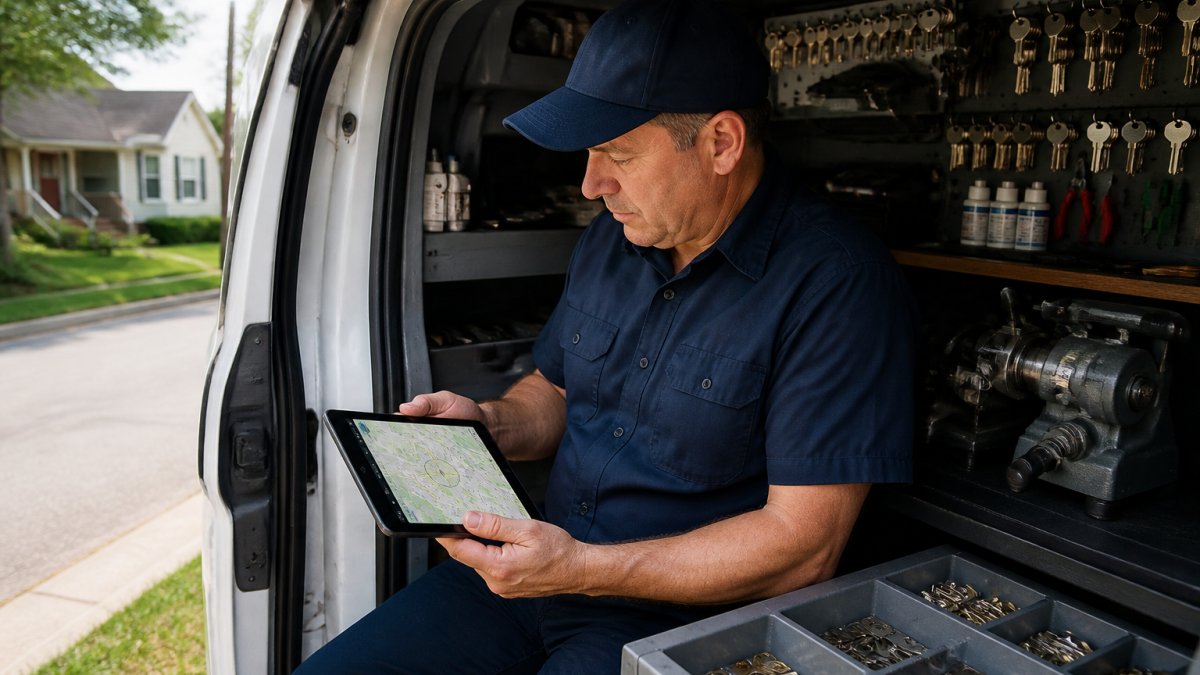
Run this checklist before you commit:
- Give your full street address and ZIP code, not just the town name
- Ask for the estimated drive time in minutes
- Confirm whether your address sits inside or outside the standard coverage radius
Using ZIP Codes and Coverage Maps to Confirm Eligibility
ZIP codes are a useful first filter but a poor final answer, a single ZIP can span dense subdivisions and rural routes 20 minutes apart in drive time.
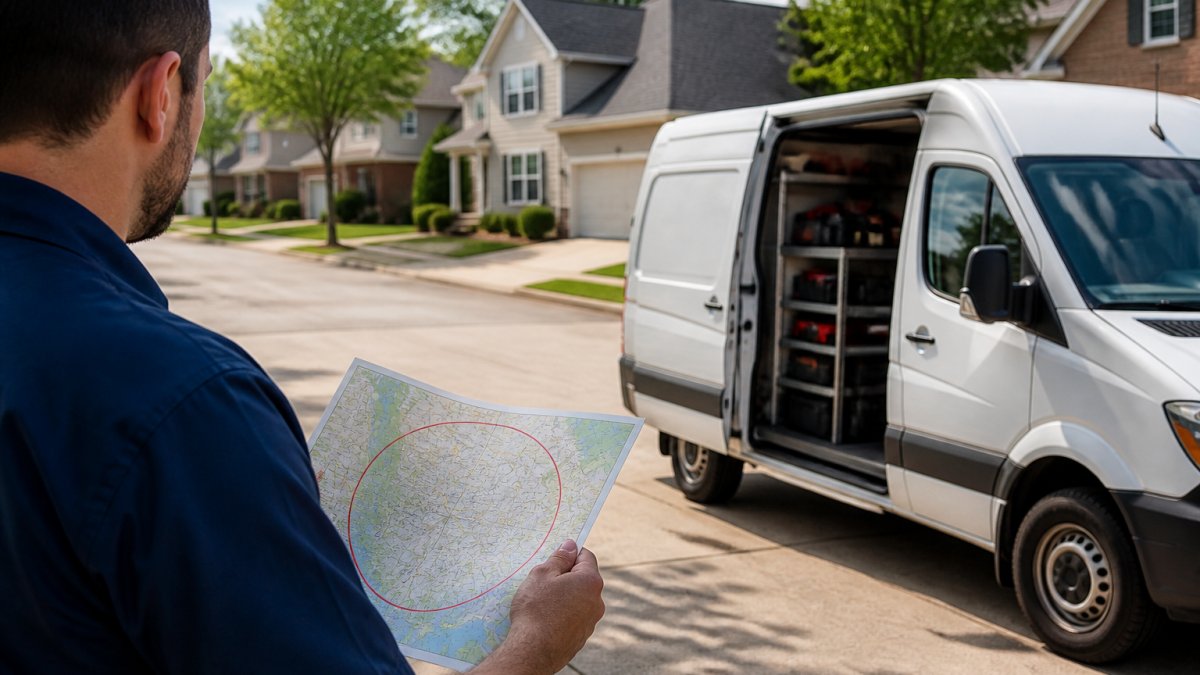
When a provider publishes a coverage map, read it as a boundary rather than a blob.
Give the dispatcher the cross streets nearest your location. If the shop maintains a coverage map, ask them to confirm your address against it while you are on the phone.
Testing the Claim Against the Road Network
The fastest way to test a coverage claim is to ask about a barrier. If a river, limited-access highway, or rail line sits between you and the shop, ask how the technician crosses it and how that affects the estimate.
A second test is the concurrent-call question: "If your nearest technician is already on a job, who is my backup, and where are they coming from?" Coverage that depends on a single technician is not coverage at all during a busy night.
What to Do If You Fall Outside the Radius
If your address sits outside a provider's boundary, the honest answer is usually a referral or a decline, and both beat a two-hour wait. Ask whether the shop can recommend a closer provider or offers a scheduled (non-emergency) appointment at a lower travel charge. For a non-urgent rekey or lock replacement, a scheduled visit from a farther shop is often cheaper than an emergency call-out from a closer one, the trade-off is time, not competence.
Questions to Ask an Emergency Locksmith Before You Commit
The right questions separate a real local provider from a call center. Ask them in this order, and listen for specifics rather than reassurances.
- "What is my estimated arrival time in minutes?" A range is fine; a vague "soon" is not.
- "Is my address inside your standard service area?" Get a yes or no, not a maybe.
- "What is the total cost, including travel and after-hours charges?" Insist on the full number.
- "Are your technicians licensed and insured?" Ask how they verify it.
- "Do you handle my specific job?" Automotive key programming, vault work, and residential rekeying are different skill sets.
- "What happens if the technician cannot resolve it on-site?" Know the fallback before you are stranded.
What to Do While You Wait for the Locksmith to Arrive
Waiting well protects your property and speeds the job. Stay with your vehicle or at your door, keep your phone on, and have proof of residency or ownership ready, since technicians may ask before working on a lock.
A few practical steps:
- Clear access to the lock, gate, or vehicle so the technician is not moving furniture or equipment
- Note the lock type if you can, which helps the technician arrive with the right tools
- Do not force the lock yourself - a failed attempt often turns a simple lockout into a lock replacement
Missed calls and misrouted dispatch cost the industry real money, with missed emergency calls averaging over USD 185 per instance according to AgentZap's locksmith phone statistics.
A lockout never happens at a convenient hour, and the wait is worse when you are not sure anyone is coming. We handle automotive lockouts and key programming, residential lockouts and rekeying, and commercial and vault work, all from a local team that knows the roads.
Frequently Asked Questions
How far will an emergency locksmith travel to reach my location?
Most emergency locksmiths define their service area radius by drive time rather than raw distance, with 15 to 25 minutes being the common standard and some extending to 30 to 45 minutes. That means a rural address 30 minutes away may be covered while a closer address across a traffic bottleneck may not be. Always confirm your address falls inside the dispatcher's stated radius before you book, and ask whether the quoted arrival estimate reflects current traffic conditions.
Does a locksmith's service area radius affect emergency response time?
Yes. The wider the radius, the longer the average emergency locksmith response time, because technicians are dispatched from a central base or their current job site. A technician already working inside a tight 5 to 15 mile radius can often arrive faster than one pulled from the edge of a 40 mile coverage boundary. When you call, ask where the nearest available technician is, not just whether your address is technically covered.
Can travel distance add an emergency locksmith travel fee to my bill?
It can. Many locksmiths charge a base service call fee plus a per-mile charge beyond a set threshold, so an address at the outer edge of the service area radius usually costs more than one close to the shop. Ask for the travel fee structure in dollars before dispatch, and confirm whether the quoted amount includes mileage, after-hours premiums, and any lock hardware. A transparent quote given over the phone should match the invoice.
What questions should I ask an emergency locksmith before booking?
Ask for the total price including travel and after-hours charges, the estimated arrival window, whether the technician is licensed and insured, and whether your specific address is inside the service area radius. Also ask what happens if the lock cannot be opened without damage and whether that cost is separate. Getting these answers before dispatch prevents the surprise fees that make callers distrust the industry.